
Ancient heart of the city that beats under kilometers of arcades that join buildings, towers, roads and convents. Explaining why Bologna is called “la Dotta” is easy: the world’s first university was born here. Every branch of knowledge has developed in this city. Bologna was in the past the city most frequented by the great names of European culture: Dante and Petrarch, Thomas Becket, Copernicus, Erasmus of Rotterdam, Paracelsus, Torquato Tasso.
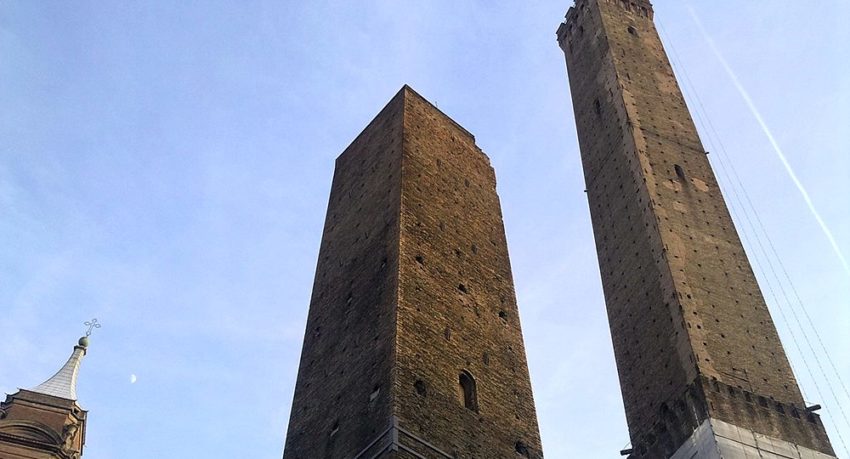
The alleys, streets, palaces and squares of Bologna are reminiscent of an extraordinary daily balance: Via Fondazza, Piazza Aldrovandi, Vicolo San Petronio up to Piazza Maggiore, the symbol par excellence of the “Italian square”, intended as a place to meet. Famous and absurd asymbol of the city, the famous towers of the Asinelli and the Garisenda tower, dressed in a substantial medieval towered nucleus.
And what about Bologna “La Grassa” where tortellini was invented inspired by Venus’ navel. The cult of Bolognese cuisine has become synonymous with Italian cuisine par excellence.




Bologna Attractions
The Church of San Francesco
 The church was built between 1236 and 1254 by the Franciscans who had settled in Bologna in 1218 with Bernardo di Quintavalle, one of the first disciples of San Francesco.
The high facade has Roman-Gothic forms, but the building was one of the first to resume the French Gothic style with great fidelity. The interior, suggestive and grandiose, is divided into three naves and the apse ambulatory has a crown of nine radial chapels; of exceptional beauty is the marble altarpiece of the high altar (1388-93) carved by the Venetians Jacobello and Pier Paolo delle Masegne. The sepulchral monuments lined along the walls are also very beautiful, including the tomb of Pope Alexander V. In the basilica is also buried Father Giovanbattista Martini, a distinguished representative of Bolognese music, who was also the teacher of Mozart when he stayed in Bologna.
Outside, towards piazza Malpighi, at the base of the flying buttresses and the buttresses supporting the vaults there are the thirteenth-century tombs of the Glossatori, tombs of some of the most famous commentators of Roman law: Odofredo, Accursio and Rolandino de ’Romanzi. During the Christmas holidays, the Franciscans set up a large mechanical nativity scene.
The arcades of Bologna
 The city boasts a vast network of medieval arcades that stretch for about 53 kilometers.
They are the ancient heart of the city that beats under the kilometers of arcades that join palaces, towers, squares and convents. You can visit all of Bologna while staying protected both with the sun and the rain.
The eighteenth century gives Bologna the longest portico in the world: The Portico of the Church of San Luca. With 666 arches and 15 chapels, the porch extends for 4 km and stands elegantly on the Guardia hill.
San Petronio
 One of the most beautiful Bolognese basilicas. San Petronio, from the 16th century, is considered among the five most important churches in the whole world.
Designed in 1390 by Antonio di Vincenzo, a great Bolognese architect, who used terracotta for its construction. Color that characterizes most of the buildings in Bologna.
The facade of San Petronio, remained unfinished, is however a reason for tourist attraction for the many people who visited Bologna. The story goes that it was the Vatican that cut the funds for the completion of the structure once they realized that there were plans to make it more grandiose than St. Peter’s Basilica in Rome.
Inside there are numerous works of art such as the altar of the enthroned Madonna and the ancient organs.
A curiosity: a meridian line is drawn on the floor (the largest in the world) in which the time is marked not by a shadow line but by a cone of light that traces the image of the sun on the floor.
Piazza Maggiore
 The Italian square par excellence. It owes its accommodation to the genius of Vignola. A square in the heart of all Bolognese and beyond.
Piazza Maggiore is the true heart of the city, surrounded by excellent shops and cafés where university students and visitors gather for the whole day. During the medieval period, it was the seat of a Roman forum, today it is increasingly a splendid setting for live music and art festivals. The buildings surrounding the square add magnificence to its grandeur.
The square is surrounded by some of the most interesting historical buildings in Bologna, some of which date back to epochs such as the Renaissance or even the Middle Ages. Among these we find the Palazzo Comunale (Town Hall), the Basilica of San Petronio, the Palazzo dei Banchi and the Palazzo dei Notai.
A suggestion to visit the city and not spend a lot is to stay in a B&B in Bologna, located near the city center, in order to allow walking and enjoy the charm of Bologna better.
Neptune
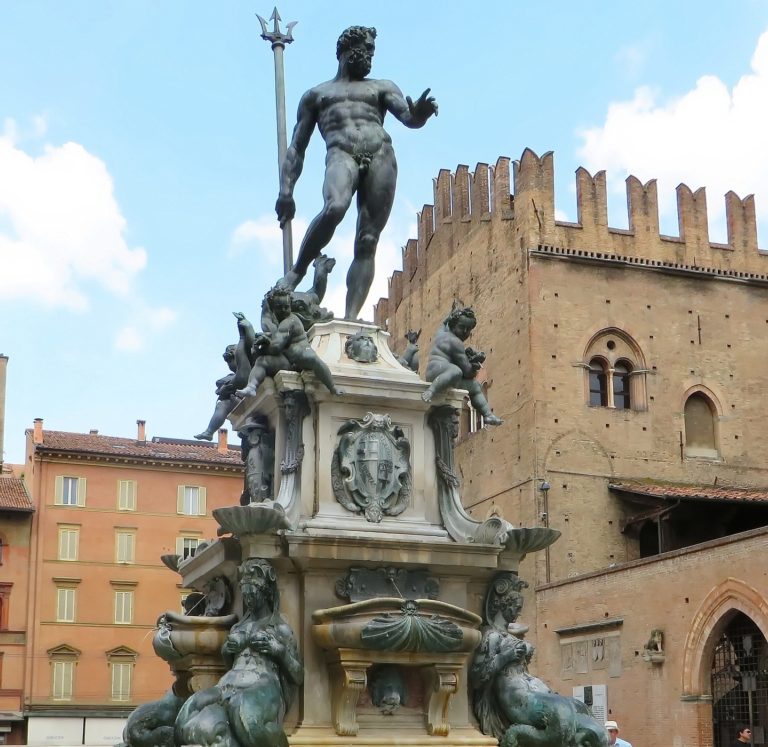
 The Fountain of Neptune which is in the center of the square of the same name and is one of the most important symbols of Bologna.
The magnificent 13th century Palazzo del Podestà overlooks this square, the former main forum of the city and Palazzo Re Enzo, named after an illegitimate son of Emperor Frederick II.
Because of its large size, the Bolognese call it “the Giant” (al Żigànt in the Bolognese dialect).
The Fountain of Neptune was built in 1563 by Tommaso Laureti from Palermo. The embellishments that you will find on the fountain were added later by Jean de Boulogne known as Giambologna.
The towers
 The two towers, well-known and taken as a symbol of the city, are the towers of Asinelli and Garisenda.
They are the survivors of a substantial medieval towered nucleus. In the eleventh and twelfth centuries, when the city slowly assumed its historical physiognomy, there were 180 towers. It is believed that in the 12th century, wealthy families competed to build high towers, each taller than the others, in the attempt to show power and wealth.
No matter what the purpose of your visit to Bologna, be it personal or corporate, you must absolutely see the Asinelli Tower and that of the Garisenda, climb about 500 steps to enjoy a spectacular view of the terracotta roofs of the historic city center. If you are looking for a place to stay in Bologna it is not difficult.
SURROUNDING
Pieve di Cento
 Walking through the small medieval village that is Pieve di Cento it seems to be in a Bologna mignon. In Pieve di Cento there is also a violin making school, a laboratory of the highest level where musical instruments are made and restored, in the Museum of Stories and in the Teatro Teatro Comunale A.Zeppilli, in particular this jewel is an Italian theater built in 1856 complete with noble stages, where shows are held today and where public officials can also celebrate weddings.
San Marino di Bentivoglio
 This town is the right place for those who want to discover all the charm of rural life of a few decades ago. At the Museo della Civiltà Contadina you can jump into the past. Palazzo Rosso is another of the cultural chocolates in this area. It takes its name from the color of its bricks and is a splendid Bolognese Liberty palace complete with halls with fine paintings on the ceilings. Not far away is the splendid Castello dei Bentivoglio, an imposing square-plan building from the 15th century with rooms, vaults, windows and decorated walls
Lamborghini Museum
 Located in Funo di Argelato, not far from Bentivoglio, there is Argelato and even if you are not a fan of motors, the visit to the Ferruccio Lamborghini Museum is worthwhile.
Walking between James Bond cars, tractors, prototypes, helicopters, the toy car that the entrepreneur built for his son when he was a child, the popemobile and even futuristic motorboats, you have the precise and exciting feeling of how brilliant, creative, intelligent and dynamic was the inventor of the legendary Lamborghinis, a worldwide recognized symbol of Made in Italy excellence
Budrio
 In its historic center bears the signs of an important and noble past. It is a very beautiful village characterized by medieval elements and arcades. If the visitor does not have much time, the truly obligatory stop is at the Ocarina Museum, with a little luck you can also attend the performance of some expert musician.
The ocarina is a simple instrument, a sort of flute that was originally only in terracotta.
Imola
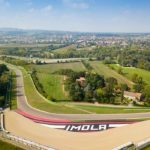 A town that preserves the ancient Renaissance system in its center, is known for the circuit where the world championship races are held.