

Discover Florence: artistic and historic heritage
Visiting Florence means immersing yourself in a magical place, the cradle of Italian culture and the Renaissance.
Florence is the capital of the Tuscany region, as well as one of the richest cities in history in all of Italy. It was the capital of Italy between 1865 and 1871, i.e. in the period of Italian unification, but already in the Middle Ages it was an important cultural, economic and administrative center, a period in which it reached its maximum splendor as the Grand Duchy of Tuscany under the dominion of the dynasty of the Medici.
Florence was the city where the artistic movement called the Renaissance originated in the second half of the fourteenth century and is also considered for this reason the world cradle of art and architecture.
The historic center of Florence, now almost entirely pedestrianized, was declared a World Heritage Site in 1982 and there are many monuments and works that are worth a visit.
Art in Florence
Florence is a city known worldwide for its artistic and architectural heritage; the most extensive artistic style is certainly the Renaissance one, even if it also counts important works of other styles.
The heart of the city is Piazza della Signoria, where several interesting civil buildings are gathered; a few minutes away is Piazza Duomo, with important religious works.
The great artists who were born or lived in Florence are also many, among the painters we find Michelangelo, Raffaello, Leonardo da Vinci, Giotto, Botticelli, Masaccio and Piero della Francesca, among the architects Vasari, Bramante, Brunelleschi and Alberti, among the sculptors Donatello and finally among the writers Dante, Poliziano, Boccaccio and Machiavelli.
Florence is full of churches, each with a particularity and for each there is at least one reason to visit it.
A treasure nestled in the heart of Italy, regal and historical. In an artistic sense, there is no equal. Countless museums, galleries, chapels and cloistures house some of the world’s most dazzling works of art by Leonardo Da Vinci, Michelangelo & Brunelleschi.
All the great places of interest are within walking distance. Browse the specialty shops for leather goods, ceramics, linens, laces, and more. The finest shops are found at the historical center of Florence. For gold & silver, the Ponte Vecchio is a must. For antiques, try the Via Maggio and the Via Dei Fossi, and great value in leather items can be found in the Santa Croce area. Don’t miss the famous straw market of San Lorenzo and the flea market on Via Pietrapiana.


Florence Attractions
Piazza del Duomo
 The remarkable Duomo or Cattedrale Di S. M. Del Fiore, with its pink, white and green marble façade and characteristic dome, dominates the city’s skyline. The building took almost two centuries to build (and even then the façade wasn’t completed until the 19th century), and is the fourth-largest cathedral in the world.
The enormous dome was designed by Brunelleschi, and its interior features frescoes and stained-glass windows by some of the Renaissance-era’s best: Vasari, Zuccari, Donatello, Uccello and Ghiberti. Take a deep breath and climb up to take a closer look, and you’ll be rewarded by fantastic views of the city and an insight into how the dome was so cleverly constructed – without scaffolding (though there’s plenty of that propping the dome up now!).
The dome still defines the scale of the city, and no building in town is taller.
 Giotto designed the cathedral’s Campanile, and Pisano and della Robbia contributed bas-reliefs. It too is clad in white, pink and green marble. The Baptistry is adjacent – it’s one of the city’s oldest buildings, and was originally a pagan temple.
The building is most famous for its gilded bronze doors. Those on the south are by Pisano, but it is the doors facing east (and in the direction of the cathedral) that are most talked about. Created by Ghiberti, they are known as the Gates of Paradise (a moniker believed to have been dubbed by Michelangelo). Created between 1424 and 1452, their beauty and sophistication mark them as one of the first products of the Renaissance. The Baptistry’s ceilings feature gory 13th-century mosaics of the Last Judgment.
Behind the cathedral is the Duomo Museum, which features original panels taken from the doors of the Baptistry, Brunelleschi’s death mask, equipment used to build the dome and an impressive sculpture collection, including pieces by Michelangelo.
Piazza della Signoria
The piazza was at the hub of Florence’s political life through the centuries, and is surrounded by some of the city’s most celebrated buildings.
Piazza della Signoria is characterized by the numerous statues, some of which are not original, that adorn the piazza and that award it wonderful admiration.
With its famous group of sculptures, the loggia looks a lot like an outdoor sculpture gallery; Cellini’s magnificent statue of Perseus and Giambologna’s Rape of a Sabine are particularly striking. Guarding the Palazzo Vecchio is a copy of Michelangelo’s oh-so-strokable David.
 The palazzo has been Florence’s town hall since 1322. Its characterful tower is another of Florence’s symbols, and the interior of the palazzo was lavishly redecorated by Vasari. An elevated corridor called Vasari’s Corridor leads from the palazzo, through the Uffizi, across the Arno by way of the Ponte Vecchio, and all the way down to the Palazzo Pitti.
The private walkway was used by the Medici family as a way of visiting their scattered palaces without having to mingle with the masses. The walkway is lined, as if merely by second thought, with works of art.
Uffizi Gallery

Backing onto the loggia, and leading all the way down to the banks of the River Arno, is the famed Uffizi Gallery.
The gallery’s wonderful collection is arranged to illustrate the evolving story of Florentine art. Some of the most famous pieces are in rooms 7-18; they include Botticelli’s Birth of Venus, Titian’s Venus of Urbino, Michelangelo’s Holy Family and Piero della Francesca’s Duke & Duchess of Urbino.
Ponte Vecchio
 If you make it out of the Uffizi with any energy and concentration left to spare, wander along the banks of the Arno towards the Ponte Vecchio.
The famous 14th-century bridge is lined with shops selling gold and silver jewellery, a step up from the butcher shops which previously lined the bridge before Cosimo I decided glitter was better than gore.
The bridge was the only one in the city to escape destruction during WW II.
Santa Croce
 If you experience a peculiar giddy feeling after visiting the Church of Santa Croce, don’t despair. It’s probable that you’ve succumbed to Stendhal’s Disease, an illness diagnosed in about 12 visitors to Florence a year, and dating from the French writer’s own feelings of culture shock and bedazzlement when he visited the church in the early 19th century. Geometrically coloured marble decorates the building’s façade (added in the 19th century), but the real treats lie inside, where many famous Florentines lie in peace, hopefully immune to the tourist footfalls. The walls are lined with tombs, and 276 tombstones pave the floor.
The church’s most famous inhabitants are Michelangelo, Macchiavelli, Galileo and Bardi. Its various chapels feature works of art by Giotto and della Robbia, and the serene cloisters were designed by Brunelleschi. Santa Croce’s museum features a crucifix by Cimabue, which unfortunately was severely damaged by the 1966 floods. Other churches which shouldn’t be missed include the statue-filled Orsanmichele; Santa Trinità, featuring frescoes by Ghirlandaio; All Saints’, with frescoes by Botticelli and Ghirlandaio; Santa Maria Novella, which contains Masaccio’s groundbreaking Trinity, along with other significant artworks; the popular SS Annunziata; Giambologna’s San Marco; and the Church of the Holy Spirit, one of Brunelleschi’s last commissions, and featuring Filippino Lippi’s Madonna & Child.
Casa Buonarroti
 Just around the corner from Santa Croce you’ll stumble across Casa Buonarroti, a house which Michelangelo owned but never lived in.
Today, you’ll find a collection of copies of the master’s work. You’ll find the real thing, however, at the Accademia Gallery: David in all his glory.
Bargello Museum
 The Bargello Museum contains the most comprehensive range of medieval and Renaissance sculpture in Italy.
Notable works include Michelangelo’s drunken Bacchus, Donatello’s David, the designs submitted by Brunelleschi for the Baptistry Doors Competition (Ghiberti won that one) and Giambologna’s Mercury. The Bargello’s heavily fortified exterior is a reminder of the building’s former life as police headquarters and prison.
Not too far away from the Bargello is Dante’s House, a small museum which examines the famous Florentine’s life.
Pitti Palace
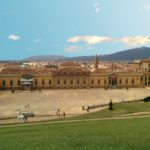 One of the most visited sites on the southern bank of the Arno, this palace was designed by the workaholic Brunelleschi for the Pitti family, rivals of the Medicis – who soon made it their own. It’s a huge and imposing building, and a treasure house of the Medici family’s massive art collection.
Treasures include works by Raphael, Filippo Lippi, Tintoretto, Veronese and Rubens, all hung in lavishly decorated rooms. The restored apartments convey the extravagant lifestyles of the Medicis, and the Savoys who later usurped their position.
The palace also houses a gallery of modern art and a costume collection. If you’re a palazzo addict, don’t miss the Strozzi Palace, one of the city’s most impressive Renaissance palaces; the Rucellai Palace, designed by Leon Battista Alberti, and today housing a photographic museum; and the Pazzi Palace, attributed to Brunelleschi.
Boboli Gardens
 Surrounding the rear of the Pitti Palace are some of Florence’s most precious and breathtaking parks: the Boboli Gardens.
A perfect example of formal Renaissance landscaping, the gardens include pools, fountains, geometric borders, tree-lined vistas, a grotto and the star-shaped Forte di Belvedere.
If you’ve got the energy, it’s worth heading down Via del Belvedere to reach Piazzale Michelangelo, which offers one of the most beautiful views of magical Florence.
The surroundings of Florence
Fiesole
 Nestled in the hilly valleys between the Arno and Mugnone rivers, beautiful Fiesole offers spectacular views of nearby Florence (eight km to the south) and is a welcome fresh-air retreat from the city bustle. The city readily reveals its Etruscan, Roman and Renaissance past, and as a summer retreat it has attracted the likes of Boccaccio, Proust, Gertrude Stein and Frank Lloyd Wright. Fiesole has a duomo, an impressive art museum and an archaeological site featuring an Etruscan temple and the remains of a Roman theatre and baths. Fiesole is especially popular as a picnic spot, and its fascinating winding streets offer atmospheric walks.
Medici Villas
 The Medicis built several opulent villas throughout the countryside around Florence during the 15th and 16th centuries. The Villa della Petraia, about 3.5 km north of the city, is one of the finest. It was commissioned by Cardinal Ferdinand de’ Medici in 1576, and features magnificent gardens. The Villa di Castello, farther north, was the summer home of Lorenzo the Magnificent and the Villa di Poggio a Caiano was a more permanent base, built for Lorenzo by di Sangallo about 15 km from Florence.
Mugello Region
 North-east of Florence, the Mugello features some of the most original villages in Tuscany. The Sieve River which winds through the grape-filled valley is popular with canoeists. The Mugello is very popular with walkers, trekkers, climbers and horse riders. Sights to look out for include the strategically positioned Montesenario Convent and the wine town of Rufina, with its viticulture museum.
Prato
 Although lying 17 km north-west of Florence, Prato has been caught up in the urban and industrial sprawl of the big city. Prato was founded by the Ligurians but was taken over by the Etruscans and the Romans. In the 11th century it was an important wool-production centre, and today it is still one of Italy’s major textile producers. The old, walled city is fortunately an intact historic island in the industrial surrounds. It features palaces, the impressive municipal art gallery and a magnificent cathedral, with a façade by della Robbia and frescoes by Filippo Lippi, Uccello and Gaddi; the cathedral houses the Virgin’s Girdle, which in the painting by Gaddi looks not unlike a hippie’s handbag. The centre also features an imperial castle, built during the 13th century.
Vinci
 The town of Vinci is the birthplace of Leonardo da Vinci. This town is 11 kms from Empoli in Tuscany and contains not only the house where Leonardo was born, but also an excellent museum featuring working models of many of his inventions with detailed explanations in four languages. The Museo Leonardo da Vinci is in a beautiful hilltop setting with views over the town and surrounding countryside and a good souvenir shop as well. Admission to the museum costs 5,000 lire per adult, children are free and it is open all day. Vinci itself is a very pleasant town with lots of restaurants and accommodation.
Barberino Val d’Elsa
 A beautiful medieval village near Florence, from which it is only 45 minutes away. Barberino can be reached by taking the Firenze-Siena highway and exiting at Tavarnelle Val di Pesae and then following the signs for Barberino di Val d’Elsa. The city has an elongated shape and for this reason the main road connects the two access doors to the town: Porta Senese to the south and Porta Fiorentina to the north. Being on the crossroads leading to the Via Francigena, Barberino has always been a welcome place, and for this reason Porta Fiorentina is the Hospital of the Pilgrims built in 1365.
Anghiari
 Among the most beautiful villages in Italy, in the province of Arezzo. Placed on a hill under which the Tiber flowed. The village, like all medieval villages, is protected by thick walls within which narrow streets branch off that run throughout the historic center.