
Traveling to Rome: a unique cultural experience in the world
Rome means history: Etruscan tombs, Roman temples, Christian primitive churches, medieval bell towers, Renaissance palaces and Baroque basilicas.
Eternal Rome is not just a way of saying. Eternal because its history is infinite and possesses the greatest vestiges of the past. Rome is great, Rome is unique in the world. It is not enough life to know it all.
Traveling to Rome offers a rich and unique cultural experience in the world.
Rome was born in 753 BC and was founded by Romulus, one of the famous twins sucked by the Lupa.
Rome has been the capital of Italy since 1870 and is the political and cultural center of the country.
The whole world must in Rome and the ancient Romans part of its culture and its inventions.
The ancient Romans have built roads connecting much of the world still used by us. The Romans also invented cement and began to use it more than 2,000 years ago. Many ancient monuments such as the Colosseum and the Roman Forum were built with this ancient form of concrete.


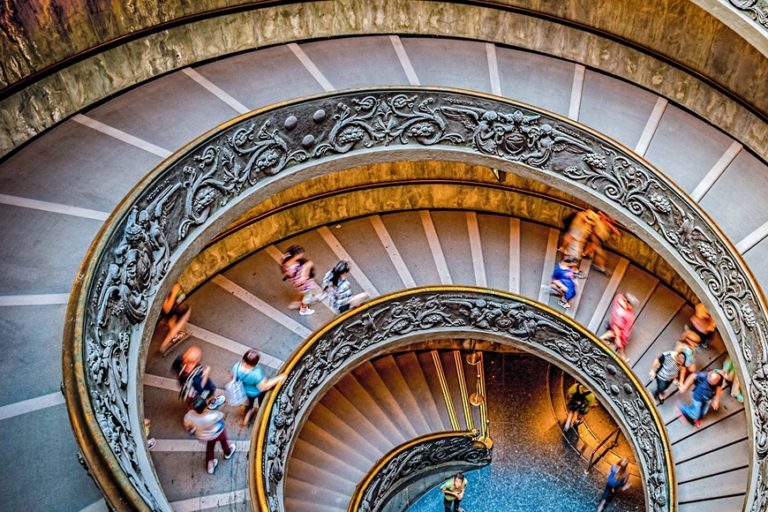
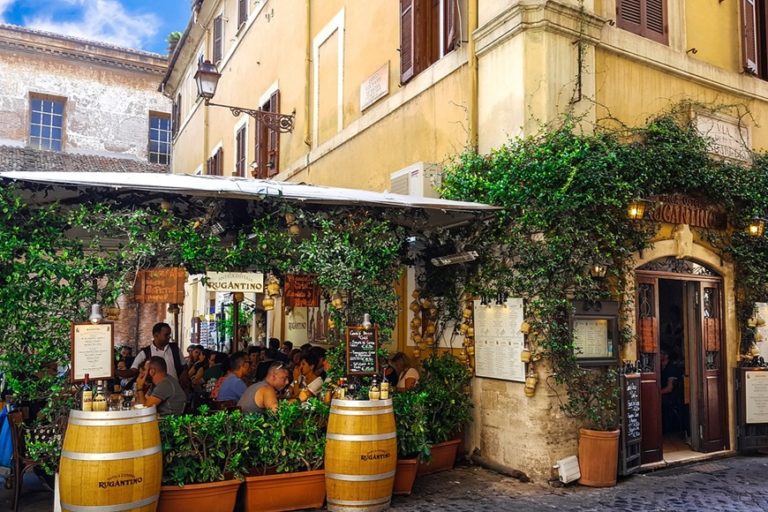
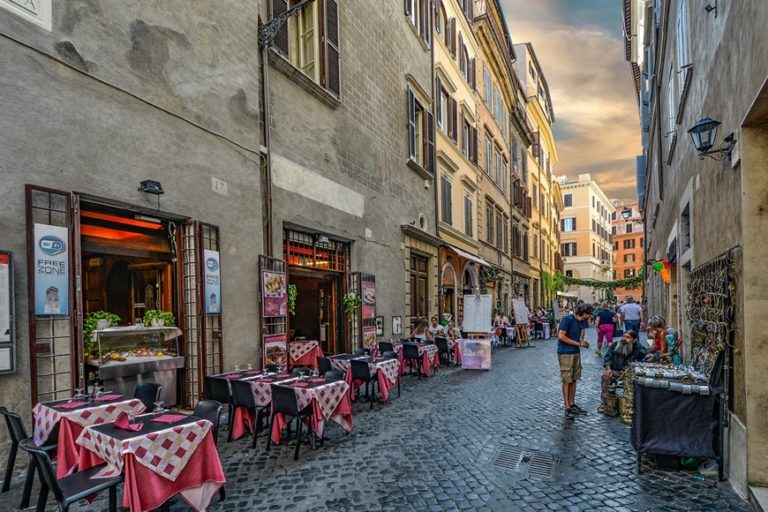
Below some of the most beautiful places to visit in Rome:
Colosseum
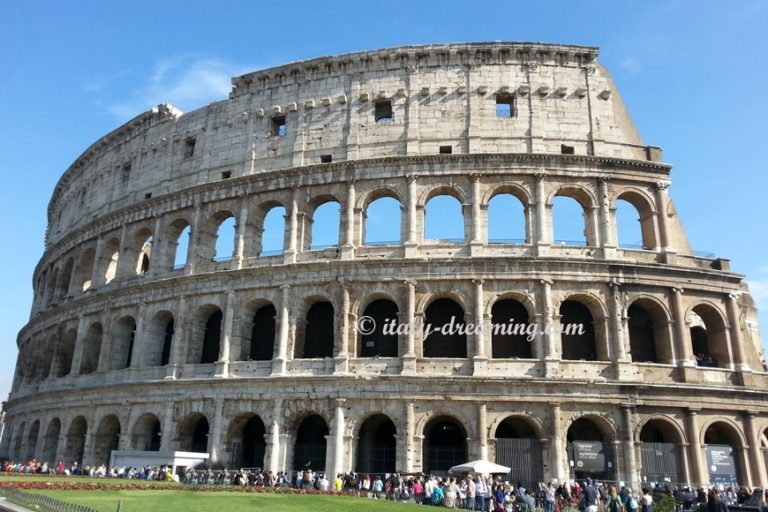
 The Colosseum is the potent symbol of the might of Ancient Rome. Called by the ancient Romans, “Anphitheatrum Flavlum” (Amphitheater Flavio), the Colosseum is the most famous and impressive monument of ancient Rome, as well as the world’s largest amphitheaterBegun in 70 A.D. by Vespasian and finished by his son and heir Titus eight years later.
This is the most famous of all Rome’s monuments where Emperors and slaves alike enjoyed watching Gladiatorial fights, mock sea battles, executions and shows involving exotic animals.
After the fall of the empire, it became in turns a fortress, a quarry, and a Christian shrine and even housed a monastery in mediaeval times.
Roman Forum
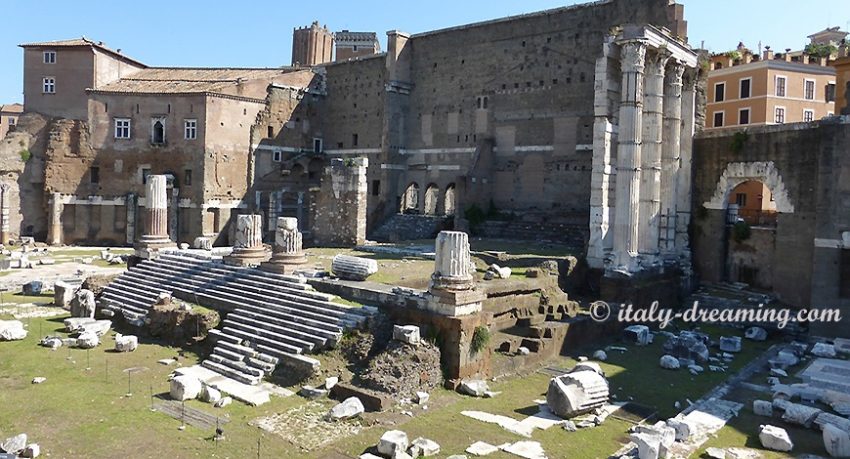
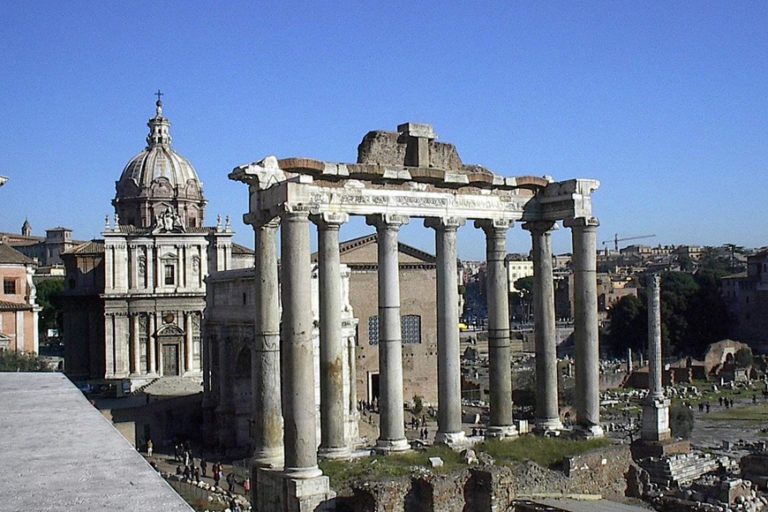
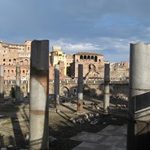 The Roman Forum was the commercial, political and religious center of ancient Rome, and stands in front of the Colosseum to find us immediately in another world: the past.
Columns that emerge from grassy and rolling hills and repositioned columns help the work of imagination.
It is located in the heart of ancient Rome in the valley between the Palatine and the Capitol and represented the political, religious and commercial center of the city of Rome.The main public activities were held in the Horsemen: basilicas were administered justice; Other buildings housed the Senate, libraries, spas, temples; Commerce was carried out in market areas connected to the port on the Tiber.
You can admire the Arch of Septimus Severus, the Temple of Saturn, the House of the Vestals, the Temple of Antoninus and Faustina and the Arch of Titus.
Palatine
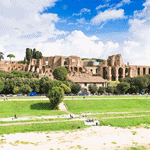 From the Forum, you can climb the Palatine, where the rich and powerful built their own palaces and temples.
It is here that everything started. According to the legend, Romulus actually chose the Palatine to found his new city, the one that would have become the center of the entire ancient world over the centuries.
Look for the Livia House, the Domus Augustana, the Flavian Palace and the ruins of the Septimus Severus Baths.
You can look at the ruins of the Circus Maximus, though not much remains of what was once a large enough track to hold more than 200,000 viewers.
Baths of Caracalla
 The Baths of Caracalla are the largest spa complex in Rome.
Archaeological and historical studies have allowed to reconstruct the original decorative structure of the Baths of Caracalla.
Written testimonies make the idea of artistic wealth present in every corner of the spa. The water system for supplying the Baths of Caracalla was also the result of great engineering and a special branch of the Aqueduct Water Aqueduct was created.
The baths were not just a bathroom building, sports and body care, but also a place for walking and studying.
Today you can still admire perfectly preserved mosaics and statues.
Campidoglio Hill
 The Campidoglio Hill was the most important of the Seven Hills of Rome.
You can admire an unexpected scenario, in the center of the square there is Marcus Aurelius elevated on a podium also drawn by Michelangelo. The statue in 1538 was transferred from the Lateran by order of Paul III. It is the only imperial equestrian statue saved by destruction, the monument turns its back to the hole looking to the Vatican as to reiterate the passage of powers from the empire to the papacy. The project of the square is by Michelangelo Buonarroti, who directed it to S.Pietro, thus setting an inverted perspective.
It was here that the Romans coined their money, kept the state records and built their most important temples, including the Temple of Jupiter where victorious generals would lay their offerings.
Michelangelo turned the square around to face the modern city rather than the Roman Forum.
The bronze equestrian statue of the Emperor Marcus Aurelius dominates a mixture of ancient Rome and the Renaissance, the centre of the square.
Theatre of Marcellus
 The Theatre of Marcellus predates the Colosseum by almost 100 years. Was hired as a model for the construction of the Colosseum.
Desired by Caesar to obscure the fame of the nearby Pompeo Theater of the rival rival, the Marcello Theater is today the only survivor of the three ancient ancient theaters of Rome.
It was started by Giulio Cesare and completed in 11 aC By Augustus who dedicated him to his nephew Marcello
Built for Augustus’ nephew and son-in-law Marcellus, and unlike the Colosseum in medieval times it was converted into a fortress and apartments built over the upper row of arches in the 14th Century.
Ghetto quarter
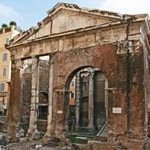 The Ghetto quarter has an atmosphere its own, like a small entire village within the city.
The whole area nowadays between the Tiber River at the height of Tiberina Island, the Portico d’Ottavia and Piazza Mattei, corresponding to the Rione Sant’Angelo, is best known by the name of Ghetto.
In 1555 Pope Paul IV ordered that all Jews in Rome should live near the river in the Sant’Angelo quarter.
Since 1870 Jewish people can live anywhere they want, the quarter retains its Jewish soul, with the Synagogue and Jewish Museum, School, Kosher bakeries and restaurants, and locals sitting out on the streets meeting and chatting with their neighbours.
In the area of the ghetto of Rome you can enjoy in typical restaurants typical of Jewish cuisine.
Isola Tiberina
 The Isola Tiberina is an island in the Tiber reached by crossing a narrow mediaeval bridge.
The Tiber Island is one of the most beautiful and suggestive places in Rome.
The island hosts a hospital, two churches, a restaurant and a synagogue. In the 3rd century B.C.
A temple was built for the God of Medicine, Aesculapius. The Tiberina island is a monument in itself since it has been worked and decorated in the shape of a ship through granites and marbles, a Roman ship with its master tree, at the time an obelisk, which seemed to sail on the Tiber.
The Ancient Romans modeled the island as a ship, and built a travertine stone bow at the downstream end and a stern upstream; part of the “bow” still survives today.
Trastevere
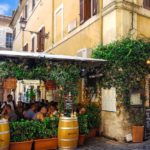 Trastevere is on the other side of the river, hence the name, meaning “Over the Tiber”. In Roman times was a port area, its inhabitants, many from the Middle East, worked in the docks and in the trades connected with the commerce of foodstuffs, and precious goods such as ivory and ebony.
Traditionally a working class area with a proud independent nature, its unpretentious “salt of the earth” character later made it popular with poets and painters. During the day its narrow winding alleyways, mediaeval architecture and quiet squares lend it a lazy atmosphere, but at night, it bursts into life due to the many bars and trattorias attracting tourists and Romans alike.
We will also look inside the beautiful Byzantine church of Santa Maria in Trastevere.
Saint Peter in Montorio
 Renaissance church built according to legend on the spot where Saint Peter was crucified.
It contains many interesting artworks and the tombs of three Irish chieftains who fled Ireland in the early 17th century, and the unmarked tomb of Beatrice Cenci, decapitated in 1599 for the murder of her brutal father.
In the cloisters, is the “Tempietto” by Bramante, a small temple noted for its perfect proportions and held to be a masterpiece of Italian Renaissance architecture.
The interior is to a nave, with four chapels per side, all originally in the form of apse, and two larger chapels forming transept. In the first chapel to the right is the “Flagellation” work by Sebastiano del Piombo of 1518 on Michelangelo’s design.
Janiculum Hill
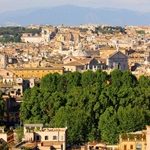 The “eighth” hill of Rome, overlooks Rome from the west and offers a breathtaking view of the city.
The name of the Gianicolo hill according to tradition would be derived from the god Giano who would have founded a town known as Ianiculum.
Site of a fierce battle in 1849 between the Garibaldi led Roman Republic and the Pro-Papal French forces.
The area, theater of heroic struggles for the Roman Republic in 1849, was transformed in 1883 by the new Italian institutions into a public walk and dedicated to the memory of the Defense of Rome.
On the edges of the avenues are the busts of the illustrious garibaldines who fought for the defense of Rome in 1849.
Church of Saint Peter in Vincoli
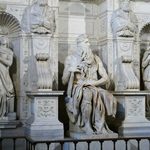 The church, first consecrated in 439 and having undergone several restorations, houses Michelangelo’s statue of Moses, which he sculpted as part of Pope Julius II’s tomb. When the statue is finished, it is said that Michelangelo was so impressed with the realism of what he had created to exclaim: “Why do not you talk?” Throwing the hammer with which he worked, against the knee of the statue.
The Basilica of St. Peter in Vincoli is named after the chains (from the ancient Latin word, chains) preserved here and which, according to tradition, were used to tie St. Peter’s chains during his imprisonment in the Prison of Mamertino.
The piazza in front is usually full of students from the nearby Faculty of Engineering.
Quirinal Palace
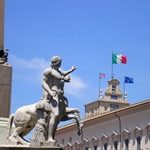 Official residence of the Italian President.
One time Papal Palace, Napoleonic troops broke into the Pope’s private quarters one night in 1809 to kidnap Pope Pius VII, who would not return to Rome until after Napoleon’s exile to Elba.
A fountain surmounted by an obelisk and flanked by five-metre tall Roman statues of the Pagan gods Castor and Pollux occupies the piazza in front of the Palace.
Among its walls were dozens of popes, from Gregory XII to Pius IX, and after the well-known historical events since 1870 became the official residence of the King of Italy and, since 1946, that of the President of the Italian Republic.
Trevi Fountain
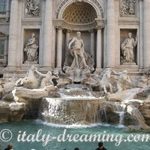 A favourite among Romans and visitors, the Trevi Fountain strikes one by surprise as you enter the small piazza at the confluence of several small narrow streets.
Built in 1732 as a “show” to mark the end of the Roman Acqua Vergine Acquaduct, which in fact still supplies the water for the fountain.
The Trevi Fountain is certainly the most scenic and the most famous among the fountains of Rome. The fountain began to take over with Urban VIII (1623-44), which decided to replace it with a great fountain and commissioned the Bernini.
Immortalised in many films, most famously of course in Federico Felini’s “La Dolce Vita.”
The most famous and ancient tradition wants those who throw a coin behind the fountain, holding their eyes closed and with their right hand on their left shoulder, will have the guarantee of returning to the Eternal City.
The Bernini Fountains in Rome
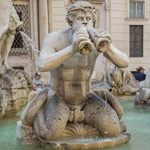 Rome has a great number of fountains in various sizes and shapes, of varying beauty and of varying fame. This large number is because they have always been considered as the best possible embellishment to a city, the furnishings ‘par excellence’. It is enough to just think of the typical, little, cast iron fountain, which is not called the Roman nose by coincidence. When speaking about fountains in Rome it is natural to immediately think of some great, famous fountains, which are not only valuable for simple, urban ornaments but are veritable works of art. Examples of this are the fountains designed and made by Gian Lorenzo Bernini, one of the greatest sculptors and architects of the seventeenth century, who also did urban planning and left signs of his greatness in other works.
The first fountain by Bernini is the Barcaccia, at the foot of the staircase of Trinità dei Monti. It is famous thanks to its privileged position. It dates from 1627-29 and was commissioned by Pope Urbano VIII Barberini, which explains the presence of Barberinian apes on the fountain. It represents an enormous ship that is slowly sinking and was meant to be a memorial of the tragic episode that took place at the end of the sixteenth century when the Tevere flooded the area. In reality, the fountain was the work of Pietro Bernini, father of the more famous Gian Lorenzo, whose son collaborated in this work.
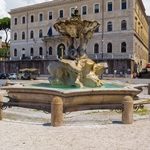 Exclusively by the Bernini son, is the Fontana del Tritone in Piazza Barberini, built between 1642 and 1643. This fountain represents a Triton in a shell surrounded by four dolphins. With this work, Bernini was symbolising the power of the Pope Barberini. In the same square is another fountain by the same artist. The Fontana delle Api, was built at around the same time and was dismantled in 1880 and only put back together in 1917 in a different position, at the crossroads of Via Veneto and Via di S. Basilio and mostly rebuilt.
Bernini’s most famous fountain, is the Quattro Fiumi, at the centre of Piazza Navona. It is said by many to be the most beautiful in Rome which accounts for its fame and was built between 1648 and 1651, in marble and travertine. The four statues represent the four rivers, symbol of the four parts of the world that were known at that time. The Danube is Europe, The Nile is Africa, the Ganges is Asia and Rio represents the Americas. In the same square is another fountain that Bernini only designed, and which was made by Antonio Mari. He was extremely loyal to the creator’s design of the Fontana del Moro, which is in the south of the square and was built in 1653. The fountain gets its name from the presence of a triton with African features that is shown fighting with a dolphin.
Pantheon
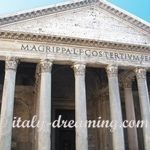 First built by Agrippa in 27 aC and dedicated to all the Olympian gods.
Hadrian had it redesigned and rebuilt in 118 AD after it was badly damaged by fire. The entrance is under a porch supported by sixteen monolithic granite columns brought from Egypt.
Its most famous feature is the self-supporting antique dome with its round central “oculus”.
The dome at the Pantheon is the largest reinforced concrete dome in the world. It is larger than the dome of St. Peter’s Basilica.
Situated in the lively and bustling Piazza della Rotonda full of pavement cafes surrounded by Renaissance buildings.
Piazza Navona
 Renaissance and Baroque architecture blend in Piazza Navona to create Rome’s most suggestive and enchanting of squares.
The long narrow shape follows the outline of the Emperor Domitian’s stadium over which it was built.
Its characteristic oval shape resembles the ancient perimeter of the underlying stage that Emperor Domiziano had built in the 86th century. For the Greek athletic games, the so-called agones from which the name of the square is derived.
Set in the centre is Bernini’s Fountain of the Rivers, in front of Borromini’s circular Saint Agnes in Agone whilst at either end lie the Fountain of the Moor and the Fountain of Neptune by Jacopo Della Porta.
Always lively and full of artists, portrait painters, mime artists and musicians.
Campo de’ Fiori
 In the mornings, Campo de’ Fiori is a bustling food market offering plenty of bright and colourful photo opportunities, and a popular haunt for people out for a drink and a bite to eat lunchtimes and evenings.
In 1600 however the unpaved piazza was the site of the philosopher Giordano Bruno’s punishment for heresy by being burned alive at the stake.
Behind is Piazza Farnese with its 16th Century Palazzo Farnese built in part by Michelangelo, and two magnificent fountains made from two giant basins originally from the Baths of Caracalla.
Perhaps Rome’s most popular spot to hang out and be pickpocketed or hassled is the Piazza di Spagna, at the foot of the Spanish Steps.
The Keats-Shelley Memorial House is nearby, and the piazza is graced by Bernini’s boat-shaped Barcaccia fountain. Elegant Via Condotti (shoppers’ heaven) runs into the piazza, and Rome’s oldest café, Caffè Greco, can be found at No 86.
Castel and Bridge of Angels
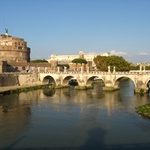 Emperor Hadrian built Castel S.Angelo in 135 AD. On the “Horti Domiziani” area to serve as an imperial tomb for himself and his successors. In 1527 Pope Clement VII retreated into Castel S. Angelo, taking advantage of the escape route of the Passetto, to escape the lanzichenecchi during the Sacco di Roma.
Always Emperor Hadrian built in 134 dC. A bridge to connect its mausoleum Castel Sant’Angelo to the other bank of the Tiber.
It is known also as the Elian bridge, after the Emperor Hadrian who styled himself on the sun god, the bridge was opened in 134 A.D. as a grand entrance to his mausoleum on the other side of the the river.
Once the only access to St. Peter’s and the Vatican. After various alterations, Pope Clement IX commissioned Bernini to restore the bridge in 1668.
Bernini adorned the bridge with ten marble statues depicting the Passion of the Christ.
Monument of Victor Emmanuel II
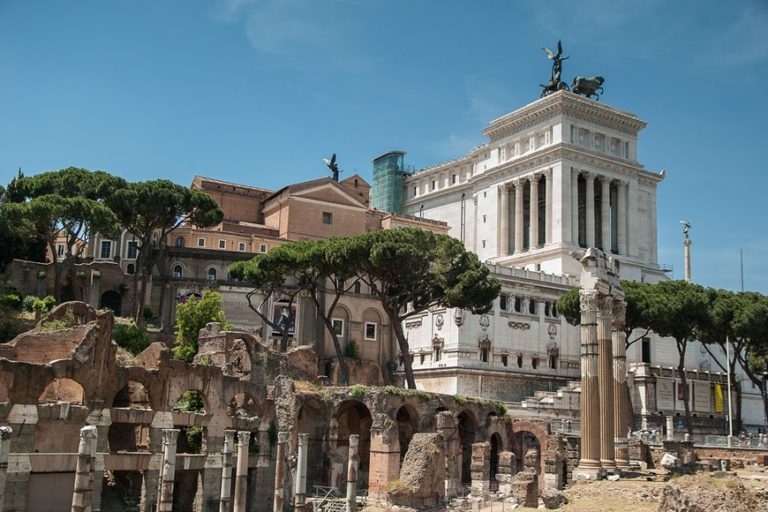
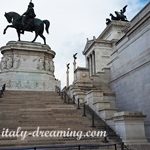 Everyone knows it as Victorian or Altar of the Homeland. Designed by the architect Giuseppe Sacconi, it stands on the Capitol. The Victorian denomination comes from the first King of Italy Vittorio Emanuele II. Since 1921, she has received the remains of the Unknown Soldier. For this reason it has become a symbol of the unity of Italy.
Since its creation, Victorian is considered one of the most representative monuments of the Peninsula..
It was made at before the start of the 20 th century. It was made to celebrate Italy’s unity and also to celebrate its first king, Victor Emmanuel II. The building is 70m high and 135m long. The building was finished in 1925.
It is well worth a visit, as the building itself it spectacular. You can also get great views of the city from the top.
Villa Borghese
 If you want to spend a tranquil day surrounded by greenery and valuable works of art, we advise you to visit Villa Borghese.
Thanks to its central position, the Villa is a perfect place for a walk in Rome.
It is surrounded by the Aurelian Walls that go from Porta Pinciana to Piazzale Flaminio.
The villa was built on this vast piece of land thanks to the work of the Cardinal Scipione Borghese, grandson of the Pope, who made it the Park of the Casino Borghese in which he gathered the precious collection of works of art, now partly displayed in the current Museum Borghese and in the Galleria Borghese, inside the Casino itself.
Ara Pacis
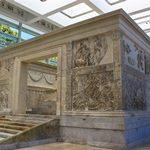 Ara Pacis is an altar dedicated to Augustus to Dea Pace, returning from the victorious military campaigns of Gaul and Spain.
One of the most beautiful and suggestive works of the Augustan art, Ara Pacis was originally to be built within the Curia for the will of the Senate, which then opted to build it in Campo Marzio, a place that was recently urbanized and served For military exercises.
The Ara Pacis looks like a rectangular fence located on a low podium with two doors set on its longer sides, inside the 3-step fence there is an altar and 5 other steps serve to allow To the priest to reach the plan on which sacrifices were celebrated.
The surroundings of Rome
Hadrian’s Villa at Tivoli
 The villa complex is the largest archaeological site in the world, bigger than even than Pompeii.
The Emperor Hadrian, one of ancient Rome’s most enigmatic and interesting figures, disliked his palace in Roma and so built a small town of over 30 buildings, covering an area of at least 1 square kilometre at Tivoli, approximately 30 Kms from Rome, or roughly a two hour horse ride from his residence in the city.
The villa contained the greatest Roman example of an Alexandrian garden.
The site included palaces, several thermae, theatre, temples, libraries, staterooms, and quarters for courtiers, praetorians, and slaves. Hadrian, who was a much-travelled Emperor, used Egyptian and Greek influences in the design of the complex. In the later years of his reign he would govern the empire from here.
Appian Way
 The Appia Antica was the most important consular road that led from Rome Capua and was later extended to Brindisi. It was actually called the “regina viarum”, which was also because of the numerous and splendid monuments along the route, many of which still exist. It was commissioned by Appio Claudio and went through a period of abandonment after the fall of the Empire.
The street is full of monuments, especially the Circus of Massenzio and many Roman tombs, like the tomb of Cecilia Metella. The route is also known for its catacombs, kilometers of tunnels sculpted in volcanic rock, which were the gathering and burial sites of persecuted Christians in Rome.
After the Porta di San Sebastiano, you will come across the Church of S. Maria in Palmis, now known as the Chiesa del Domine, quo vadis? According to legend, it was called this because of the question that St. Peter asked Jesus. Continuing along this road, you will reach the Basilica di S. Sebastiano, who was a victim of the Diocleziano persecutions. The basilica is dedicated to the saint and his body is buried here, although it was originally dedicated to the apostles, Peter and Paul. The underground catacombs here are worth a visit and can be reached by a staircase. Continue along to what once must have been an immense villa. Villa di Massenzio also had a mausoleum, called Romolo which was built by Massenzio himself in memory of his son who died at a young age. However, one of the most enchanting roman monuments in the area is surely the Tomb of Cecilia Metella, a noblewoman who died young, in front of which is the gothic church of S. Nicola a Capo di Bove, which gave its name to the surrounding area.
The Appia Antica then continues along an almost deserted route, with cypresses and pines and some ancient, Roman ruins, some of which can be individually recognised such as the Tomba dei Curiazi. After this, places of notable interest include the Villa dei Quintili, whose remains are called Old Rome and Casal Rotondo, which is the largest sepulchre on the Via Appia and is therefore, better to visit by car.