

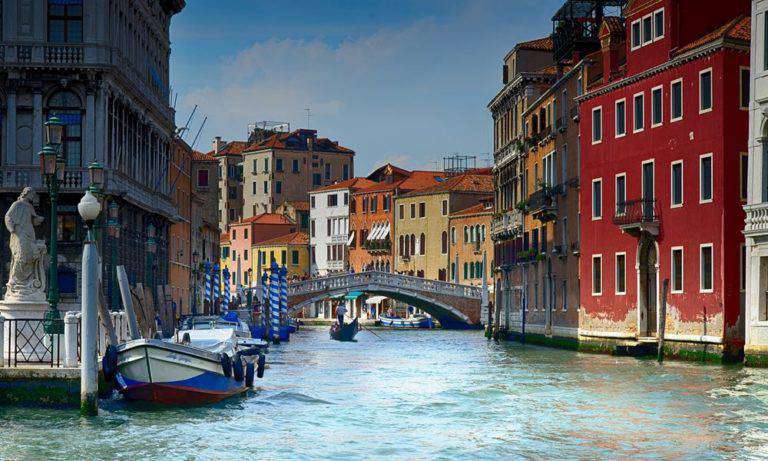
There’s no escaping it: Venice is unique. For a start, this is a pedestrian’s city on a very human scale, cars are almost nonexistent, and beguiling narrow paths take the place of ugly city roads. The harmonious architecture seems to have sprung uniformly from somewhere between the 12th and 16th centuries, its secretive walls and enticing balconies sparkling with flashes of water glimpsed through cracks and windows. Dark paths suddenly emerge into the clear, bright daylight of a church-filled square or to cross the city’s myriad canals by way of numerous and wonderful little bridges. The atmosphere is magical, and inexplicably festive.
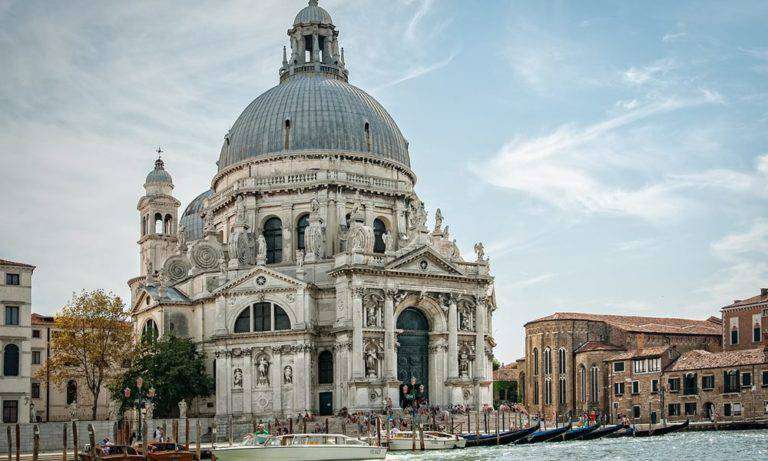
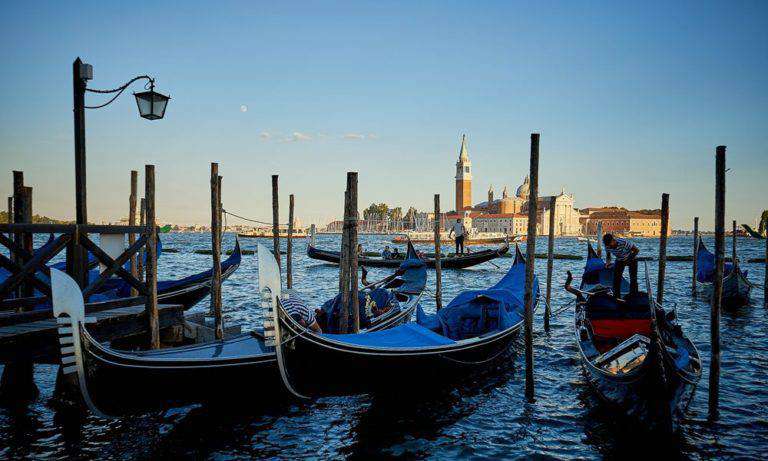
The city is built on 117 small islands, and is linked to the mainland service town of Mestre by a road and rail causeway. The Grand Canal insinuates itself around the city, emerging at the unforgettable vista of Piazza San Marco, boasting its campanile, Doges’ Palace, St Mark’s Basilica and elegant pigeon-filled piazza. The Bridge of Sighs links the palace to the gloomy old prisons, and the bobbing gondolas are overlooked by the stunning Santa Maria della Salute, San Giorgio Maggiore and del Redentore churches. It takes only half an hour or so to walk from the train station to San Marco: that is if you can resist the temptation to take one of the many paths that diverge from the main drag. To appreciate the fine palaces that line the Grand Canal, swallow your ‘but I’m not really a tourist’ phlegm and take a gondola.
The Accademia Bridge leads to a quieter Venice and the Galleria dell’Accademia, with its collection of Venetian masters. The nearby Peggy Guggenheim Gallery updates your walk through history and art, with its fine collection of early-20th-century works. Venice is surrounded by equally enchanting islands: the Lido (forever linked with Tommy Mann, Dirk and Death in Venice), Murano (the home of Venetian glass), Burano (famous for its lace) and strangely time-warped Torcello, with its Byzantine cathedral.
The best way to get around in Venice is on foot. But be sure to take to the water on a waterbus ride along the Grand Canal past scores of elegant palaces. You may not be able to resist a traditional gondola ride. Shoppers will be spoiled by Venice. The principal shopping street of Mercerie runs from Piazza San Marco to the Rialto. Typical Venetian masks can be found in abundance. The islands of Murano & Burano are the best places to buy traditional glass & lace.


Venice Attractions
Ca’ d’Oro
 This magnificent Gothic structure houses the Galleria Franchetti, an impressive collection of bronzes, tapestries and paintings from the 15th and 16th centuries; many works are by Titian. A big incentive for visiting is the chance to take in the panorama from the balconies over the Grand Canal on the 1st and 2nd floors.
The magnificent 15th-century structure was named for the gilding that originally decorated the facade’s sculptural details. The 1st floor of the museum is devoted mainly to religious painting, sculpture and bronzes from the 15th and early 16th centuries. One of the first items you see is a polyptych recounting the martyrdom of St Bartholomew.
Take a closer look at the detail. The violence is quite remarkable, as is the saintly indifference with which Bartholomew seems to accept his torment! Much of what you see on this floor is Venetian, but one room has been set aside principally for Tuscan art.
On the 2nd floor you can see a series of fragments of frescoes. All are by Titian except one, an exceptional nude by Giorgione. Also on this floor is a mixed collection, including works by Tintoretto, Titian, Carpaccio, Mantegna, Vivarini, Signorelli and van Eyck.
Gallerie dell’Accademia
 The Gallerie dell’Accademia houses Venice’s single most important art collection, brilliantly illustrating the progression of Venetian art from the 14th to 18th centuries. The highlights here are Paolo Veneziano’s Madonna and Child with Two Donors and Carpaccio’s altarpiece Crucifixion and Apotheosis.
The art tour kicks off in the meeting hall of the Scuola Grande di Santa Maria della Carità, the oldest of the Scuole Grandi (Venice’s six major lay confraternities). The highlights here are Paolo Veneziano’s Coronation of Mary and Carpaccio’s altarpiece Crucifixion and Apotheosis.
The next rooms house brilliant works by Giovanni Bellini, in particular his Madonna with Child Between Saints Catherine and Mary Magdalene, and Giorgione’s mysterious Tempest. Works by Titian are followed by Lorenzo Lotto’s Portrait of a Young Gentleman in His Studio and Tintoretto’s Theft of St Mark’s Body and Crucifixion.
Moving on chronologically, we come to characteristic landscapes by Canaletto and Guardi, and interiors by Pietro Longhi. The tour backtracks to end with the vibrant 15th-century crowd scenes of Carpaccio’s Miracles of the True Cross and Gentile Bellini’s Procession in San Marco, bringing the past alive with fine attention to detail.
Palazzo Ducale
 The Piazzetta San Marco is overlooked by the exquisite Palazzo Ducale, for centuries the city’s political heart. The pink and white Venetian Gothic fantasy housed the doge, the many arms of government and a couple of prisons.
The doge’s first-floor apartments are followed by a succession of increasingly grandiose state rooms on the second floor, including the Sala delle Quattro Porte (design by Palladio, paintwork by Titian and Tintoretto), the Anticollegio (four Tintorettos and Veronese’s Rape of Europa), the Sala del Collegio (yet more Veroneses and Tintorettos), culminating in the immense Sala del Maggiore Consiglio (featuring Tintoretto’s Paradiso, one of the world’s largest oil paintings, and Veronese’s Apotheosis of Venice).
A trail of corridors leads you to the small, enclosed Bridge of Sighs, which crossed from the palace into the New Prisons. Breathe a sigh of relief and exit from the main entrance, the gloriously Gothic Porta della Carta.
Rialto
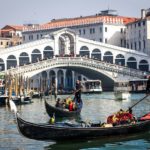 The Rialto has always been the commercial heart of Venice, so it’s hardly surprising that the first bridge over the Grand Canal was built here. Today the area is still famous for its bustling fruit & veg market, but because of its central position, the bridge itself is neck-deep in stalls selling tourist souvenirs.
The neo-Gothic arches of the Pescaria are only a hundred years old, but the tradition of selling fresh fish here goes right back to 1300.
The city’s oldest church, the Chiesa di San Giacomo di Rialto, is virtually in the middle of the market and was supposedly founded on 25 March 421, the same day as Venice itself.
Cross the bridge to head into San Polo, and you’ll come to one of Venice’s most sublime religious treasure troves, Santa Maria Gloriosa dei Frari. The Frari was built by the Franciscans and stars Giovanni Bellini’s poignant sacristy altarpiece and Titian’s gloriously uplifting Assumption altar painting.
St Mark’s Basilica
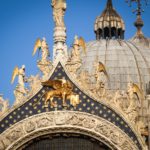 St Mark’s is one of the most spectacular houses of worship in the world, attesting to the Venetian Republic’s former maritime and commercial might. Adorned with an incredible array of plundered treasures, it is a seething mass of domes and arches. The dress code requires knees, shoulders and upper arms be covered.
The basilica was modelled on Constantinople’s Church of the Twelve Apostles and consecrated in 1094. It is famous for its golden mosaics, particularly those above the doorways in the facade and decorating the interior domes. If you can wrench your eyes away from their glitter, take time to admire the 12th-century marble pavement.
The basilica’s many treasures include the gleaming Pala d’Oro altarpiece of gold, enamel and precious jewels. The Tesoro (Treasury) contains most of the booty from the 1204 raid on Constantinople, including a thorn said to have come from the crown worn by Christ.
On the loggia above the main door are copies of the delightful prancing horses that were also hijacked from Constantinople (the gilded-bronze originals are on display inside). The basilica’s 10th-century campanile collapsed without warning on 14 July 1902, and was rebuilt brick by brick over the following 10 years. Take the lift to the top for some fabulous views over the rooftops and lagoon.
St Mark’s Square
 Napoleon dubbed it the ‘finest drawing room in Europe’, and visitors and pigeons alike have been flocking here for centuries to strut and crow. There is a constant carnival atmosphere thanks to the cacophony of duelling cafe orchestras, cooing pigeons, and constant traffic of waiters serving alfresco diners.
Now that most visitors arrive in Venice via the railway station, the magical symbolism of the waterside Piazzetta San Marco has to a great extent been lost.
The piazzetta’s two columns bear emblems of the city’s patron saints: the winged lion of St Mark and the figure of St Theodore. St Mark’s Square is one of the lowest parts of the city, and so is always the first to be covered in water when the acqua alta (high tide) arrives – a magical sight on a moonlit night!
The surroundings of Venice
Burano
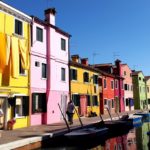 Bustling Burano is famous for its fishing and lace industries. The village’s pastel-coloured houses have appeared on countless postcards, but they’re more than just pretty façades – they say that the bonbon colours have their origins in the fishermen’s desire to be able to see their own houses when heading home from a long day at sea. Given the island’s distance from Venice (around 40 minutes by ferry) you really do get the feeling of having arrived somewhere only fleetingly touched by La Serenissima. Take time out to wander into the quietest corners and shady parks, crossing over the wooden bridge to neighbouring Mazzorbo – a larger island with little more than a few houses, a couple of trattorie and open green space. Choose carefully if you plan to buy lace on Burano, as these days much of the cheaper stuff is imported from Asia. That said, you can still occasionally see women working away at their lacy creations in the shade of their homes and in the parks. The Museo del Merletto explores the craft and history of Burano lace.
Murano
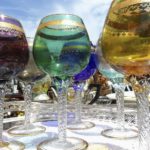 Sleepy Murano has long been famed for its glass production – since the 10th century, in fact, when the secrets of the art were smuggled into Venice by merchants trading in the East. Once ensconced in Murano, the methods of the craft became such a well-guarded secret that it was considered treason for glass-workers to leave the city.
Watching the glass-workers in action in factories on the island is fascinating. You can see them in several outlets along Fondamenta dei Vetrai and a couple on Viale Garibaldi. Look for the sign ‘Fornace’ (furnace).
The Museo Vetrario is devoted to the art and history of glasswork, and there are some exquisite pieces on display. The island’s architectural highlight is the Veneto-Byzantine Basilica di SS Maria e Donato, with its colonnaded apse and 12th-century mosaic pavement.
Pellestrina
 Near the southernmost tip of the Lido, Pellestrina is a small island, home to fishing villages, lacemakers and Murazzi, the seawalls of Istrian stone that protected the lagoon for 200 odd years. Island of lace and fishermen from the beautiful beaches.
A walk along the deserted ribbon of grey sand (at low tide!) is the perfect antidote to those crowded Venetian alleyways.
Pellestrina is the place to catch a firsthand glimpse of the lagoon’s Murazzi, the seawalls of Istrian stone that protected the lagoon from the Adriatic’s swell from 1782 until the horrific floods of 1966.
Pellestrina is little more than an 11km (7mi) sandbank lining these walls.
Torcello
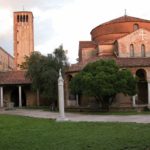 For an atmospheric glimpse of pre-Republican Venice, take a ferry to the distant scrub-covered flats of Torcello, in the north of the lagoon. This far-flung, marshy and truly eerie islet was where the first mainlanders sought a safe haven from the barbarian invasions, and it is where the story of Venice began. Torcello has a magical, otherworldly atmosphere, with an overgrown main square, abandoned buildings and monuments, and canalside walks leading nowhere. It was once home to some 20,000 people, but fewer than 80 call the ghost town home today. The magnificent Byzantine mosaics in the Chiesa di Santa Maria Assunta are a striking reminder of Torcello’s former glories, and a couple of good trattorie (including an unrelated version of Cipriani’s) make the visit even more worthwhile.